Rival IQ Review 2026: Pricing, Pros, Cons & Who It Fits
Rival IQ Review 2026: Pricing, Pros, Cons & Who It Fits
Rival IQ is a social media analytics platform built around competitive benchmarking, social listening, and automated reporting. It is not a publishing or scheduling tool. Instead, it answers a narrower but strategically important question: how does your brand's social performance compare to your competitors, and what should you do about it?
This review is based on product documentation, verified user feedback on G2 and Capterra, and a direct feature comparison published by Socialinsider. It covers what Rival IQ does well, where it falls short, how pricing is structured, and which teams get the most value from it.
What Rival IQ actually does
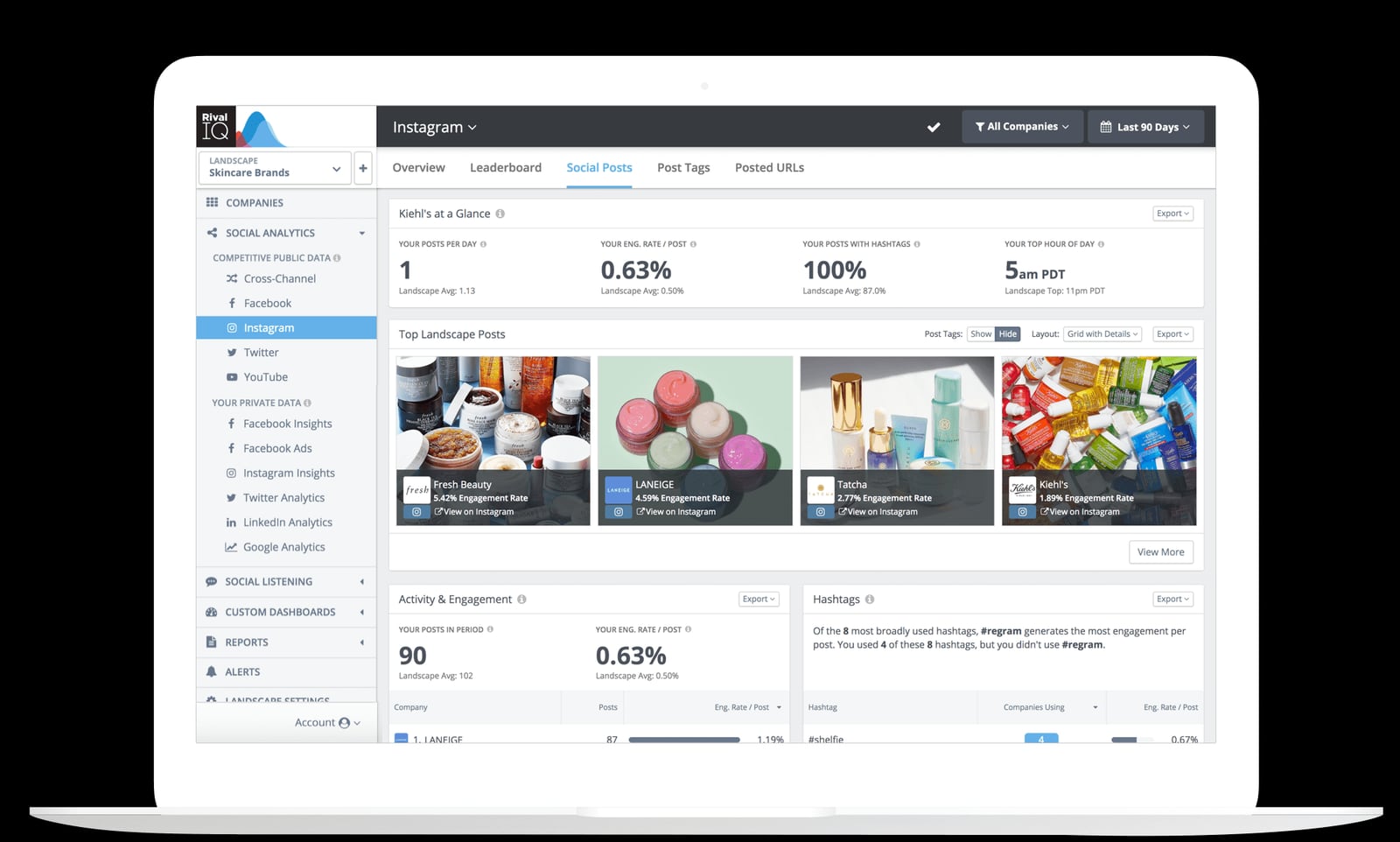
Rival IQ product interface.
Rival IQ monitors public social accounts across Facebook, Instagram, X (Twitter), TikTok, and LinkedIn, then organizes that data into competitive landscapes. A landscape is a group of accounts you want to compare: your own brand plus a set of competitors. Within a landscape you can view cross-channel performance or drill into a single network.
The platform's core outputs are:
- Competitive benchmarking — side-by-side metrics such as follower growth, engagement rate, post frequency, and average engagement.
- Post-level analysis — which formats, topics, and posting times drive engagement for you and your competitors.
- Social listening — keyword and hashtag monitoring to surface conversations, mentions, and influencer activity.
- Alerts — notifications when competitors hit engagement spikes or when tracked keywords appear.
- Reporting — scheduled and on-demand reports, plus a Google Data Studio connector and API access on higher tiers.
G2 reviewers consistently highlight ease of use and reporting depth, while Capterra reviewers describe it as strong for trend analysis and fast social audits. Those two themes — speed and clarity — define the product's positioning.
Who Rival IQ is built for
Rival IQ product interface.
Rival IQ fits teams that need competitive context more than they need a publishing calendar. Typical users include:
- Brand marketing teams in consumer packaged goods, health and beauty, retail, and higher education that report on share of engagement against named competitors.
- Agencies that run competitive audits for clients and need repeatable, presentable reports without building a data pipeline.
- Nonprofits and institutions that benchmark against peer organizations rather than commercial rivals.
- Social media analysts who want post-level trend data without writing SQL or configuring a BI tool.
If your primary need is scheduling posts, managing an inbox, or approving content across a team, Rival IQ is the wrong category of tool. A scheduling-first platform such as Sendible or Metricool would be a better starting point, and you can layer Rival IQ on top for analysis.
Strengths: where Rival IQ earns its reputation
Rival IQ product interface.
Fast competitive benchmarking
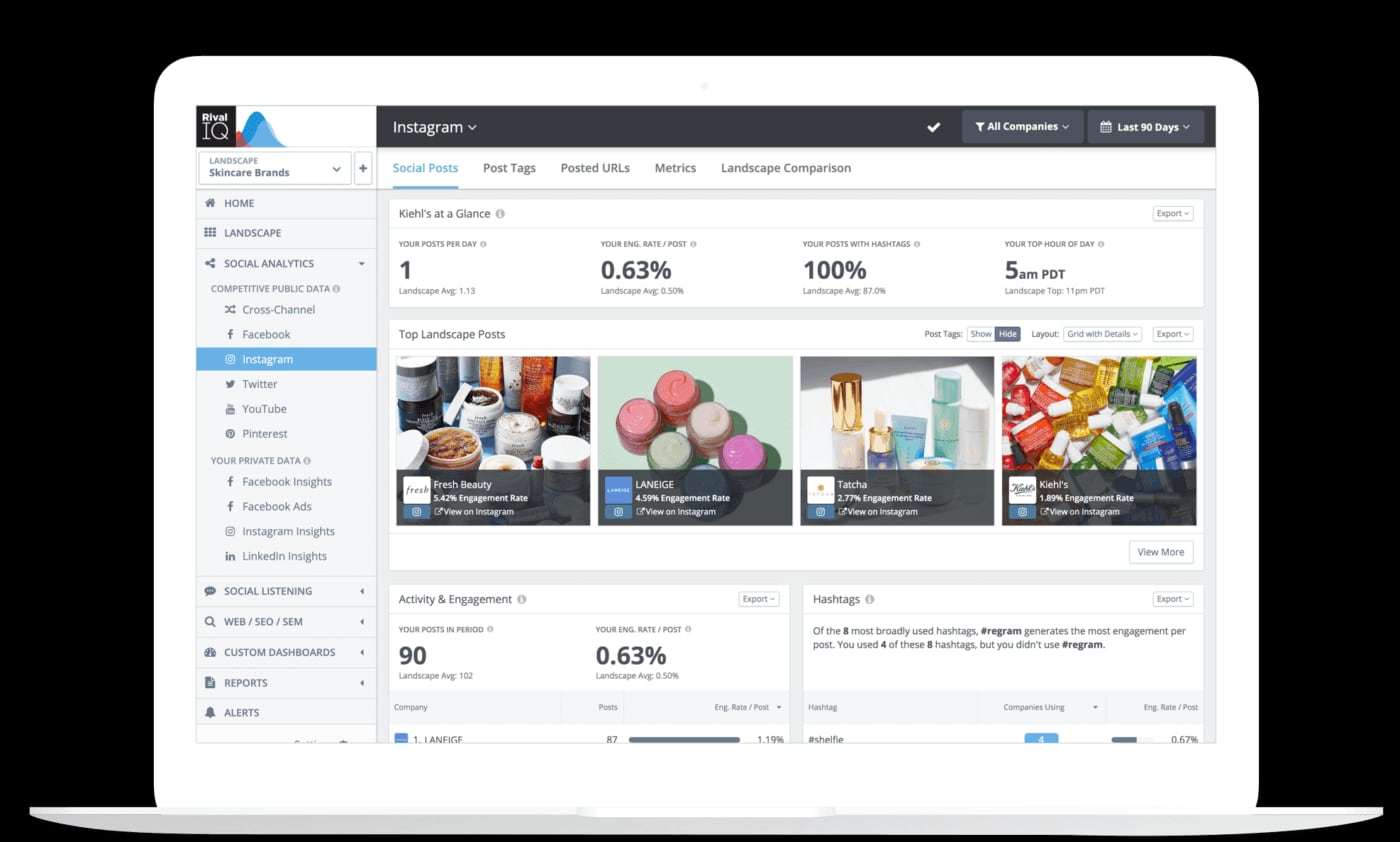
The landscape model is the product's strongest idea. You define your brand and competitors once, and the platform keeps the comparison current. The overview screen shows audience growth, activity, and engagement side by side, which is exactly the view an executive or client wants in a quarterly review.
Post-level insight without data science
Rival IQ surfaces top-performing posts, engagement by format, and content themes across a competitive set. You do not need to export raw data or build pivot tables. This is the practical middle ground between a native analytics dashboard and a full BI stack.
Social listening and hashtag tracking in the same workspace
Because listening data sits next to benchmarking data, you can connect a competitor's engagement spike to a campaign or hashtag rather than treating them as separate investigations. That context is genuinely useful for campaign post-mortems.
Reporting that stakeholders accept
Scheduled reports, the Google Data Studio connector, and API access on higher tiers mean the data can flow into whatever format your organization already uses. Reviewers on G2 repeatedly mention reporting as a reason they stay.
A real educational library
Rival IQ publishes industry benchmark reports, case studies, and training webinars. The benchmark reports are useful even if you never buy the product, because they give you industry engagement baselines to sanity-check your own numbers.
Limitations: what to weigh before buying

Rival IQ Review 2026: Pricing, Pros, Cons & Who It Fits - Limitations: what to weigh before buying.
LinkedIn competitive data is a weak spot
According to Socialinsider's direct comparison, Rival IQ does not support LinkedIn competitor data at the same depth as some rivals. For B2B brands whose competitive set lives on LinkedIn, this can be a dealbreaker. If LinkedIn benchmarking is central to your strategy, compare options carefully — our Socialinsider review covers a platform that treats LinkedIn page and post data as a first-class feature.
Benchmarking context is relative, not absolute
Rival IQ compares you to the competitors you select. It does not automatically place you against a broader industry benchmark inside the landscape view. If you choose a weak competitive set, your numbers will look better than they are. You need to curate your landscape deliberately, or supplement with published industry benchmarks.
It is an analytics tool, not a publishing tool
There is no content calendar, no approval workflow, and no unified inbox. Teams that want one platform for scheduling and analytics will need to pair Rival IQ with something else, or choose a broader suite.
Pricing is quote-based
Rival IQ does not publish a simple self-serve price list. The three tiers — Drive, Engage, and Engage Pro — are typically sold through a demo and a custom quote. That makes budgeting harder and favors teams that already know their requirements.
Depth versus breadth trade-off
Some competitors go deeper on specific channels or offer features like organic value estimation that translate engagement into estimated ad-equivalent spend. Rival IQ's strength is breadth across major networks with consistent reporting, not maximum depth on any single one.
Pricing signals: what to expect
Rival IQ sells three tiers:
| Tier | Typical fit | Notable inclusions |
|---|---|---|
| Drive | Small teams starting with benchmarking | Core competitive analytics across supported networks |
| Engage | Brands and agencies with regular reporting needs | Expanded reporting, more landscapes, team access |
| Engage Pro | Data-mature teams | Private data analysis, Facebook Ads reporting, Google Data Studio connector, API access |
Because pricing is quote-based, the practical signal is this: the entry tier is designed for teams that mainly need competitive benchmarking, while the Pro tier is priced for organizations that want to move Rival IQ data into their own systems. If you need API access or Facebook Ads reporting, assume you are in the top tier and budget accordingly. Request a quote with your actual number of landscapes, competitors, and users, because those variables drive the number.
Setup and onboarding
Setup is lighter than most analytics implementations:
- Create a landscape. Add your brand and the competitors you want to track. Start with five to eight competitors — enough for context, few enough to keep reports readable.
- Connect owned accounts. Link your own social profiles so the platform can pull your performance data alongside competitors'.
- Configure listening. Add keywords, brand terms, and hashtags you want monitored. Keep the list tight at first to avoid alert noise.
- Set alerts. Choose which competitor events or keyword mentions should trigger a notification.
- Build or schedule reports. Decide who receives what, and how often. Weekly for working teams, monthly or quarterly for stakeholders.
The main onboarding risk is landscape sprawl. Adding twenty competitors feels thorough but produces reports nobody reads. A focused landscape with clear reporting cadence delivers more value.
How Rival IQ compares to alternatives
- Versus Socialinsider: Socialinsider leans harder into benchmarking depth, cross-channel brand grouping, LinkedIn analytics, and organic value estimation. Rival IQ counters with a simpler landscape model and a strong reporting workflow. For B2B and LinkedIn-heavy programs, Socialinsider has the edge; for teams that want fast cross-network snapshots, Rival IQ is competitive.
- Versus all-in-one schedulers: Tools like RADAAR or Ocoya combine publishing, inbox, and analytics. They win on workflow consolidation but generally do not match Rival IQ's competitive benchmarking depth.
- Versus native platform analytics: Free and built in, but siloed per network and with no competitor context. Rival IQ's value is the cross-network, cross-brand view.
Decision criteria: should you choose Rival IQ?
Choose Rival IQ if:
- Competitive benchmarking is a recurring deliverable for leadership or clients.
- Your competitive set is active on Facebook, Instagram, X, or TikTok.
- You want post-level trend insight without a data team.
- You need scheduled reports and, at the top tier, API or Data Studio access.
Look elsewhere if:
- LinkedIn competitor data is essential to your strategy.
- You need scheduling, approvals, and an inbox in the same platform.
- You require transparent, self-serve pricing before a sales conversation.
- You need maximum analytical depth on a single network rather than consistent coverage across several.
A practical middle path: keep a scheduling tool for publishing and add Rival IQ purely for competitive intelligence. Many agencies run exactly this split.
Sources and further reading
- Rival IQ Reviews 2026: Details, Pricing, & Features - G2 - Users consistently praise the ease of use and robust reporting features of Rival IQ, which help them effectively track and analyze their competitors' social ...
- Rival IQ Software Pricing, Alternatives & More 2026 | Capterra - "A great tool for analyzing trends on social media." ... Rival IQ is excellent for keeping track of the main trends in social networks, it does very fast audits ...
- Socialinsider vs. Rival IQ : Which One Is More Powerful for Performance Reporting? - Explore the key differences between Socialinsider and Rival IQ. Find out which social analytics platform offers the best data for your needs.
FAQ
Is Rival IQ a scheduling tool?
No. Rival IQ is an analytics and competitive intelligence platform. It does not publish posts, manage approvals, or provide a social inbox.
Does Rival IQ support LinkedIn competitor data?
LinkedIn is among the supported networks, but independent comparisons indicate its LinkedIn competitive depth is weaker than some dedicated analytics rivals. Verify current LinkedIn coverage with Rival IQ directly if this is a priority.
How much does Rival IQ cost?
Pricing is quote-based across three tiers: Drive, Engage, and Engage Pro. Costs scale with landscapes, competitors, users, and features such as API access and Facebook Ads reporting. Request a tailored quote rather than relying on list prices.
Is Rival IQ good for agencies?
Yes, for the analytics and reporting side of agency work. Agencies that also need publishing and client approvals typically pair Rival IQ with a scheduling platform.
What is a landscape in Rival IQ?
A landscape is a saved group of social accounts — your brand plus selected competitors — that the platform analyzes together across supported networks.
Does Rival IQ offer a free trial?
Trials and demos are typically arranged through the sales process. Check the official site for current trial availability.
Conclusion
Rival IQ does one job well: it turns public social data into competitive context that non-analysts can act on. Its landscape model, post-level insights, and reporting workflow make it a credible choice for brands, agencies, and institutions that benchmark against named competitors on Facebook, Instagram, X, and TikTok.
Its limits are equally clear. LinkedIn competitive depth is a known gap, benchmarking is relative to the competitors you pick, and pricing requires a sales conversation. It is also not a publishing tool, so most teams will run it alongside a scheduler.
If competitive benchmarking is a standing requirement in your reporting cycle, Rival IQ is worth a demo. If you mainly need to publish, engage, and manage content, start with a scheduling platform and revisit analytics once your reporting needs mature.