Cross Border Digital Review 2026: Services, Pricing & Fit
Cross Border Digital Review 2026: Services, Pricing & Fit
Cross Border Digital is a Shenzhen-headquartered international digital marketing agency that has been operating since 2008. Founded by Charles Coxhead and Allen Qu, it helps Western brands enter the Chinese market and Chinese brands expand internationally, with a team spanning China and the Philippines. This review examines what the agency actually offers, where it fits best, and the trade-offs you should weigh before engaging it.
Unlike software tools such as Meltwater or Brandwatch, Cross Border Digital is a services firm. That distinction matters: you are buying strategy, execution, and local market knowledge rather than a dashboard. The evaluation criteria are therefore different — team depth, market access, and process transparency matter more than feature lists.
What Cross Border Digital Actually Does

First viewport screenshot of BiliBili for brand marketing in China - Cross Border Digital.
The agency positions itself as a full-service international growth partner rather than a single-channel specialist. Its core service lines include:
- International growth strategy — market prioritization, localization planning, and channel mix decisions for entering new regions.
- International SEO — technical and content optimization for search engines across multiple markets, including Baidu for China-facing work.
- Multi-language content marketing — localized content production rather than translation-only workflows.
- International GEO (Generative Engine Optimization) — optimizing brand visibility inside AI-generated answers and large language model outputs.
- Digital PR — earned media and authority building across target markets.
- Online reputation management — monitoring and shaping brand perception in search and social results.
The combination of SEO, GEO, and reputation work is notable. Most agencies still treat these as separate engagements. Cross Border Digital bundles them, which reflects how search visibility now spans classic results, AI overviews, and social platforms simultaneously.
The two-directional model
The agency's most distinctive structural feature is that it serves traffic in both directions:
- Inbound to China — Western brands needing Baidu visibility, Weibo and BiliBili presence, and Chinese-language content.
- Outbound from China — Chinese brands needing Google, Western social platforms, and English-language market entry.
This dual model is rare. Most agencies specialize in one direction. The advantage is that the team understands both ecosystems from the inside; the risk is that a dual focus can dilute depth in any single market.
Who Cross Border Digital Is Best For
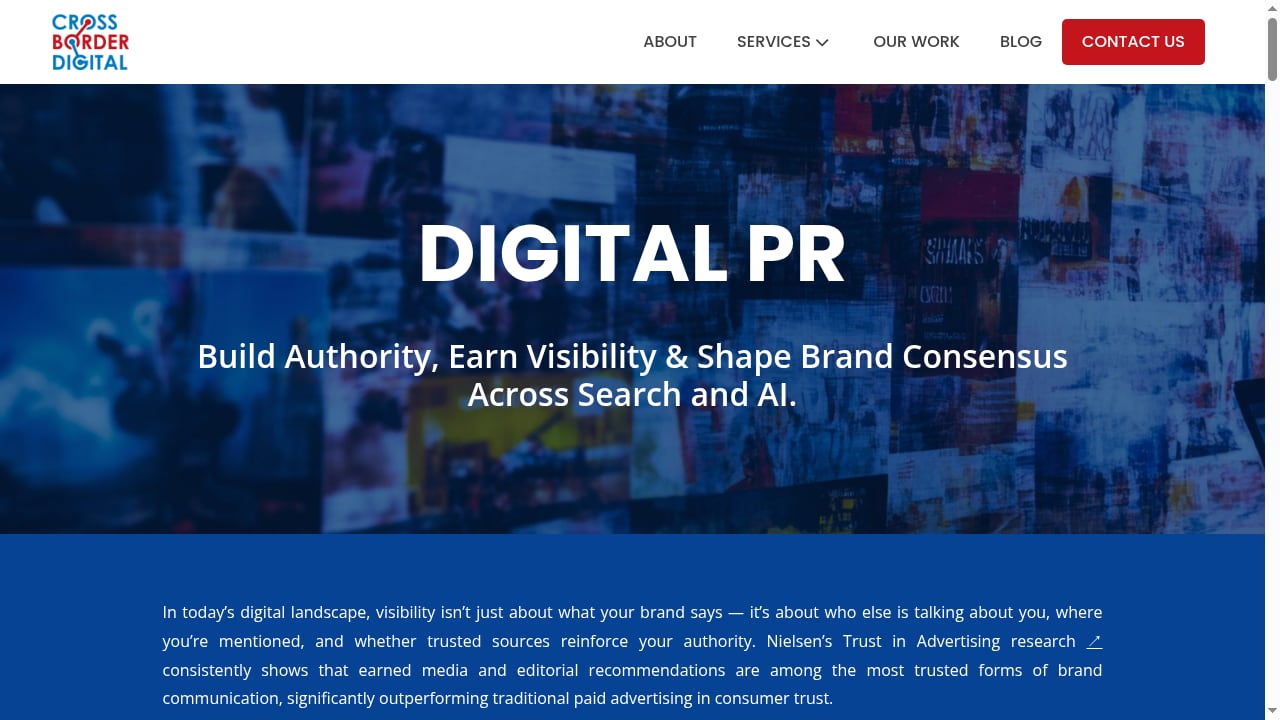
First viewport screenshot of Digital PR - Cross Border Digital.
Based on the service mix and stated positioning, the agency fits these profiles well:
| Profile | Why it fits |
|---|---|
| Western B2B or B2C brands entering China | Needs Baidu SEO, local content, and platform-specific expertise |
| Chinese brands going global | Needs Google SEO, Western PR, and English content |
| Mid-market companies with a real budget | Agency retainers require sustained investment, not one-off projects |
| Brands already doing SEO but failing at localization | The agency's core differentiator is localization depth, not raw link building |
| Companies worried about AI search visibility | GEO services address a gap most traditional SEO agencies ignore |
Who it is probably not for
- Startups with under $2,000/month budgets — agency retainers rarely make sense at this scale; a tool like Awario or a freelance specialist is more efficient.
- Brands wanting pure link building — this is a strategy-led agency, not a commodity backlink vendor.
- Companies needing only social scheduling — tools such as Sked Social cover that need at a fraction of the cost.
Strengths Worth Noting

SEO & GEO Experts.
Longevity. Operating since 2008 means the agency has survived multiple major search algorithm shifts, the rise of mobile, and now the AI search transition. That track record is meaningful in an industry where many agencies disappear within three years.
Founder-led market knowledge. Charles Coxhead and Allen Qu built their experience working with Australasian online brands before expanding into cross-border work. That background suggests practical commercial grounding rather than purely academic market theory.
Genuine bilingual capability. A team split between China and the Philippines is not just a cost structure — it is an operational requirement for producing native-quality content in both Chinese and English.
Integrated channel thinking. The agency explicitly combines organic and paid channels rather than treating SEO as an isolated discipline. For cross-border campaigns, this integration matters because paid and organic performance feed each other in unfamiliar markets.
Educational content depth. Their blog covers topics like SEO vs GEO vs AEO, China marketing strategy, and platform guides for Weibo and BiliBili. This signals current, hands-on knowledge rather than recycled general advice.
Limitations and Trade-offs
Pricing opacity. Like most agencies in this segment, Cross Border Digital does not publish rates. You will need a discovery call to get numbers. Expect retainers in the mid four figures per month and up, depending on scope and market count. Budget accordingly and ask for a clear scope breakdown.
Agency timelines. Cross-border SEO is not fast. Baidu ranking, Chinese content approval cycles, and Western PR outreach all take months. If you need results in 30 days, an agency engagement is the wrong model.
Dual-market breadth risk. Serving both directions is a strength in positioning but can mean less specialization than a China-only or West-only boutique. Ask directly which team members would handle your account and what their specific market experience is.
No published case study metrics. The agency shares proof points around longevity and founder background, but public performance data is limited. Request references and specific outcome metrics during evaluation.
Dependence on relationship management. With services firms, results depend heavily on the assigned account team. The agency brand matters less than the individuals doing the work.
Pricing Signals: What to Expect
Cross Border Digital does not publish pricing, which is standard for strategy-led agencies. Based on the service scope — international SEO, content, GEO, PR, and reputation management — realistic engagement ranges are:
- Entry-level single-market SEO retainer: roughly $2,500–$5,000 per month
- Multi-market international program: $5,000–$15,000 per month
- Full cross-border strategy with PR and GEO: $15,000+ per month
These are estimates based on the agency's positioning, not published rates. Treat them as a budgeting starting point and verify directly. For comparison, software-only alternatives like Mention cost a fraction of this but deliver monitoring rather than execution.
Questions to ask before signing
- Which specific team members will work on my account, and where are they based?
- What does the first 90 days look like in deliverables, not promises?
- How do you measure GEO performance separately from traditional SEO?
- Can you share two references in my industry and market direction?
- What is the exit or transition process if we pause the engagement?
Setup and Onboarding Process
Expect a structured onboarding rather than an immediate campaign launch. Typical agency onboarding for this type of engagement includes:
- Discovery and market audit — reviewing your current search visibility, content, and competitive position in target markets.
- Strategy document — market prioritization, channel mix, and a 6–12 month roadmap.
- Technical foundation work — site architecture, hreflang, and localization infrastructure.
- Content and authority building — localized content production, digital PR, and reputation work.
- Reporting cadence — usually monthly, with quarterly strategy reviews.
The setup phase typically takes four to eight weeks before meaningful execution begins. Plan for this in your timeline.
Decision Criteria: Should You Choose Cross Border Digital?
First viewport screenshot of Contact Us - Cross Border Digital.
Use this framework to decide:
Choose Cross Border Digital if:
- You need genuine China market entry capability, not just translated content.
- You want one partner covering SEO, GEO, PR, and reputation together.
- You have a sustained budget and a 12-month+ horizon.
- You value bilingual execution over lowest-cost delivery.
Look elsewhere if:
- You need a single-channel tactical execution at low cost.
- You want published, transparent pricing before a sales conversation.
- You need fast results within one quarter.
- You only need monitoring or scheduling software.
For broader context on how cross-border data and digital trade shape these decisions, the CSIS analysis of digital trade rules and the UNCDF brief on cross-border data flows are useful background reading on the regulatory environment your campaigns operate within.
Related reading
- dlvr.it Review 2026: Pricing, Features, Pros & Cons - Hands-on dlvr.it review for 2026: RSS and social auto-posting to 21 networks, pricing signals, setup, limitations, and who it really suits.
Sources and further reading
- Cross-border digital platforms and discretionary adaptation strategy ... - In today's digital era, many exporters in emerging markets (EMEs) participate in cross-border digital platforms to conduct business internationally.
FAQ
Is Cross Border Digital a software tool or an agency?
It is a services agency, not a SaaS platform. You engage it for strategy and execution, not for a self-serve dashboard.
Does Cross Border Digital publish its pricing?
No. Pricing is quoted after a discovery process. Budget for mid four-figure monthly retainers and upward depending on scope.
Can Cross Border Digital help a Chinese brand expand internationally?
Yes. The agency explicitly serves both directions — Western brands entering China and Chinese brands going global.
What is international GEO, and does Cross Border Digital offer it?
GEO stands for Generative Engine Optimization — improving how your brand appears in AI-generated answers. Cross Border Digital lists it as a core service alongside international SEO.
How long before results appear?
Cross-border SEO and localization typically show early signals in three to six months, with meaningful compounding results after nine to twelve months.
Does Cross Border Digital work with small businesses?
It can, but agency retainers usually make more sense for mid-market companies with sustained budgets. Smaller businesses may get better value from focused tools or freelancers.
Conclusion
Cross Border Digital occupies a specific and useful niche: bilingual, strategy-led cross-border marketing with real depth in both the Chinese and Western digital ecosystems. Its longevity since 2008, founder experience, and integrated SEO-GEO-PR model are genuine strengths. The trade-offs are the ones that come with any agency engagement — pricing opacity, longer timelines, and dependence on the assigned team.
If you need a partner who can operate credibly in both directions and you have the budget and patience for a proper program, it is a credible shortlist candidate. If you need fast, cheap, or single-channel execution, look at software alternatives or specialists instead. Either way, ask for specific team assignments and outcome references before committing — that is where agency engagements succeed or fail.