Ayrshare Review 2026: Social Media API for Developers
Ayrshare Review 2026: Social Media API for Developers
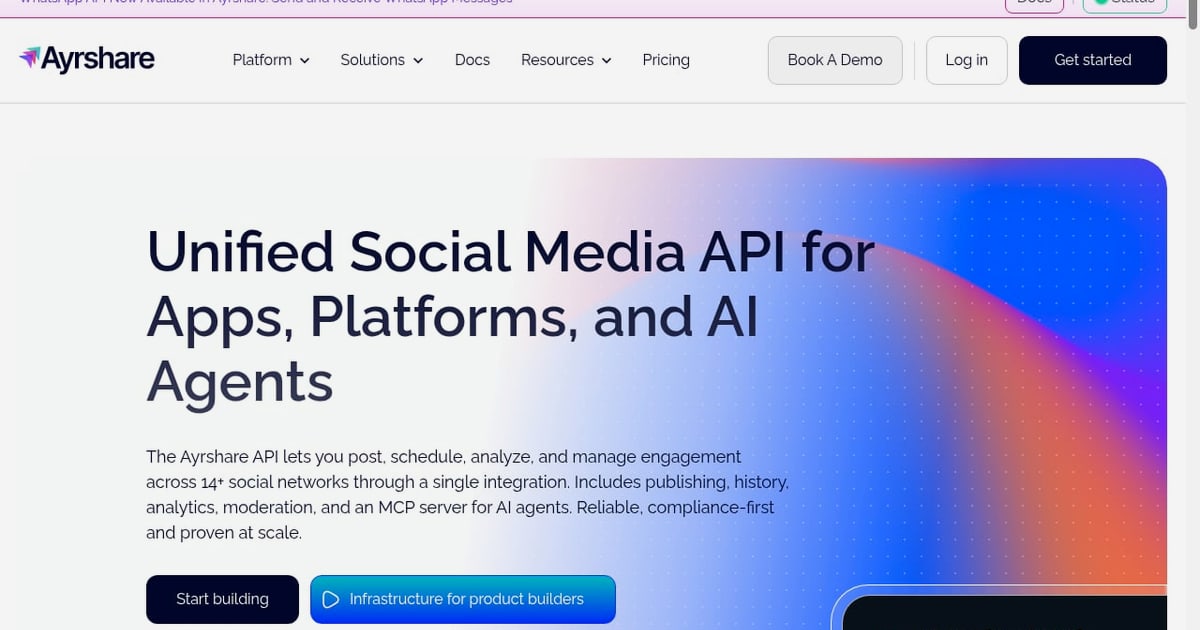
Ayrshare is a unified social media API that lets developers and product teams publish, schedule, analyze, and manage engagement across 14+ networks through a single integration. If you are evaluating it for a SaaS platform, CMS, agency workflow, or AI agent, this review breaks down what it does well, where it falls short, and how to decide whether it fits your stack.
What Ayrshare Is and Who It Serves
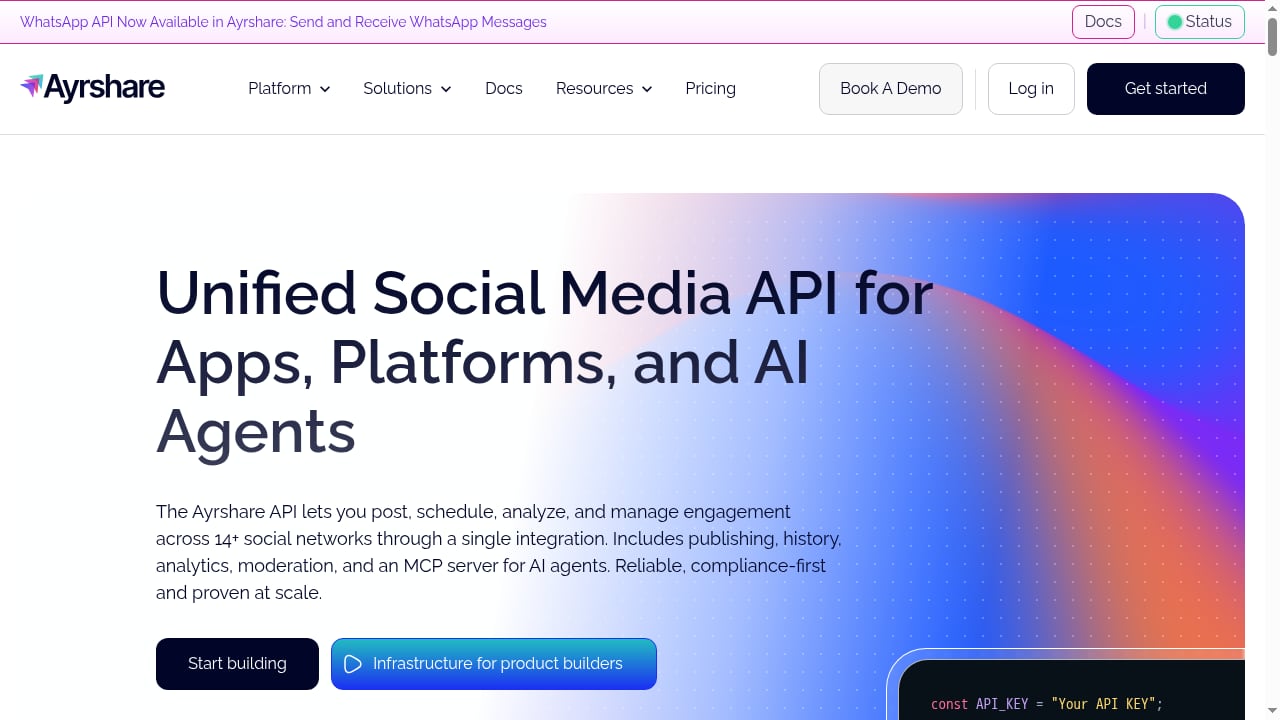
First viewport screenshot of Unified Social Media API for Apps, Platforms, and AI Agents.
Ayrshare is infrastructure, not a dashboard-first social media tool. Its core value is abstracting the fragmented APIs of Instagram, Meta, TikTok, Twitter/X, LinkedIn, YouTube, Google Business Profile, and others into one consistent interface. That means one authentication model, one posting payload, and one set of analytics endpoints instead of a dozen platform-specific integrations.
The product context positions it for product builders, SaaS platforms, CMS and DAM vendors, agencies, and AI startups. The company reports 10,000 teams using it, from early-stage AI startups to Fortune 500 companies, with 30M+ daily API calls and 99.99% API uptime. Those are vendor-reported figures, but they align with the platform's positioning as compliance-first infrastructure built for scale.
Ideal users
- SaaS and app developers who need to add social posting to their product without building and maintaining 14 platform integrations.
- Agencies and white-label platforms that manage social accounts on behalf of clients and need multi-tenant account handling.
- CMS, DAM, and marketing workflow vendors that want to push content directly to social channels from their existing tools.
- AI startups and agent builders using MCP servers to let AI agents publish and manage social content programmatically.
Poor fits
- Solo creators who want a visual calendar and inbox. A dashboard tool like SocialBee or Socialync will be faster to adopt.
- Teams that only need one or two networks. The abstraction overhead is hard to justify when a single native API is enough.
- Non-technical marketers without developer support. Ayrshare assumes you can make HTTP requests, handle webhooks, and manage API keys.
Core Capabilities
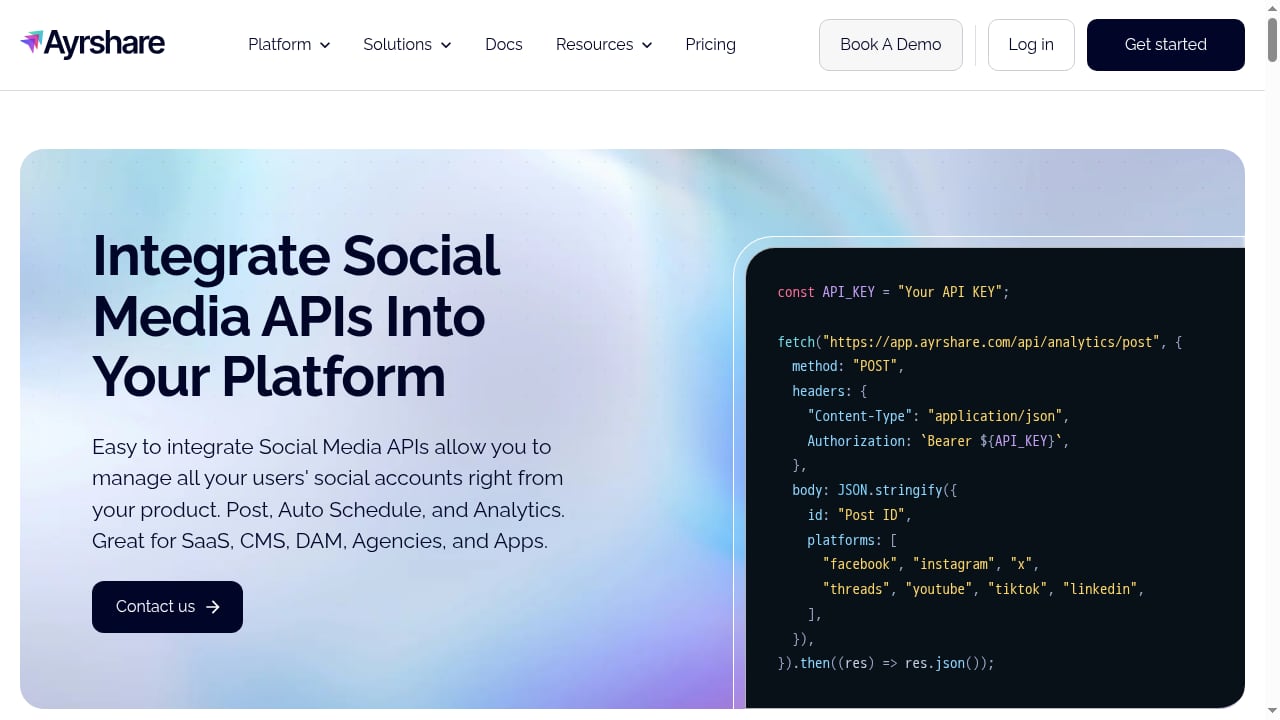
First viewport screenshot of Business Plan: Integrate social media APIs into your platform.
Ayrshare's feature set is organized around what product teams actually need to embed social functionality:
- Publishing and scheduling: Post text, images, video, and platform-specific formats to connected accounts, either immediately or queued.
- Post history and analytics: Retrieve past posts and engagement metrics across networks through normalized endpoints.
- Engagement and moderation: Read and respond to comments, and moderate user-generated content where the platform APIs allow it.
- Multi-user and multi-tenant support: Manage end-customer social profiles under one API key structure, which is essential for SaaS and agency models.
- MCP servers for AI agents: Expose social posting and management as tools that AI agents can call, which is a differentiator as agent workflows mature.
- Developer resources: Documentation and error guides for common issues across Instagram, Meta, TikTok, Twitter/X, LinkedIn, YouTube, and Google Business Profile.
What the abstraction actually saves you
Cross-platform social APIs are genuinely painful. Each network has its own OAuth flow, token refresh behavior, rate limits, media requirements, and review process. Meta and TikTok, in particular, require app review and audit before you can post on behalf of users at scale. Ayrshare absorbs that compliance and maintenance burden, which is the strongest argument for using it.
Pricing Signals and Business Model
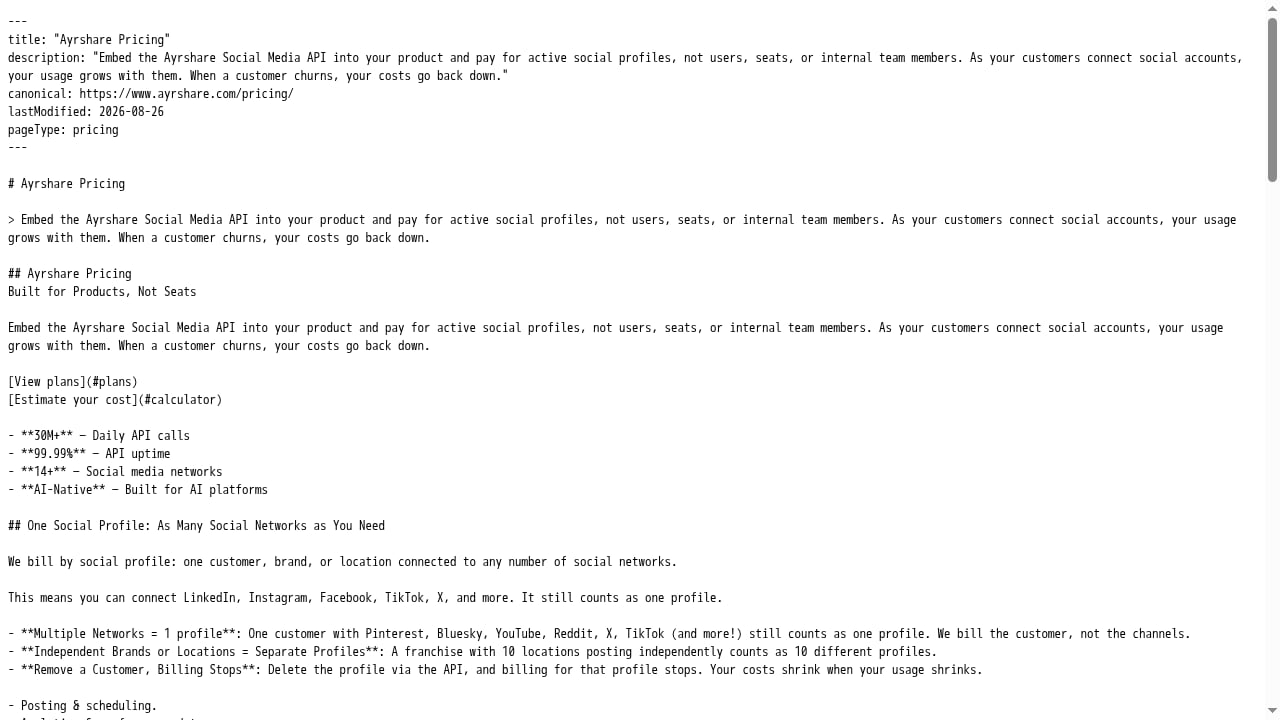
Ayrshare's pricing model is built for products, not seats. Costs scale with active social profiles rather than internal users or team members. That has two practical implications:
- You can add team members without increasing cost. Engineering, support, and account management can all access the same account.
- Costs decrease when your customers churn. If an end user disconnects their social accounts, you stop paying for those profiles. For SaaS businesses, this aligns infrastructure cost with revenue.
This is a meaningful contrast with per-seat tools. A dashboard platform like Hootsuite charges by user and often by social account, which can become expensive as your team grows. Ayrshare inverts that: your bill tracks the social connections your product manages, not the people managing them.
Exact plan tiers and per-profile rates change, so verify current pricing on Ayrshare's site before committing. The strategic signal is clear: it is priced for embedded, multi-tenant use, not for a single marketing team.
Setup and Developer Experience
First viewport screenshot of www.ayrshare.com.
The setup path is API-first:
- Create an account and generate an API key. You will get a primary key for your workspace.
- Connect social accounts. Ayrshare provides a linking flow (often via a hosted URL or JWT-based flow) so end users can authorize their own accounts.
- Send your first post. A single POST request with a platforms array and content payload publishes to multiple networks.
- Handle webhooks and errors. You will need to process post status callbacks and handle platform-specific errors, which Ayrshare documents in its error guides.
- Scale to multi-tenant. Use user profiles or business profiles to isolate each customer's accounts.
The learning curve is moderate. If your team is comfortable with REST APIs, OAuth, and webhooks, you can ship a basic integration in days. The harder work is product-level: designing the UX for account connection, handling disconnects, and surfacing platform errors in a way your users understand.
Automation platform path
Ayrshare also works well through automation tools like Make.com and n8n. G2 reviewers specifically mention how easy it is to post to multiple platforms via these platforms. This is a legitimate low-code route for agencies and internal ops teams that do not want to build a full backend integration.
Strengths
- One integration, many networks. The core value proposition holds up: you avoid maintaining separate code paths for each platform.
- Built for multi-tenant products. Profile-based pricing and account isolation fit SaaS and agency models better than per-seat tools.
- Compliance and review handling. Navigating OAuth audits and platform reviews is a major hidden cost; Ayrshare absorbs much of it.
- MCP support for AI agents. This positions Ayrshare well for agent-driven workflows, which is where a lot of product development is heading.
- Developer documentation. Error guides and platform-specific notes reduce trial-and-error during integration.
Limitations and Trade-offs
- Not a visual tool. There is no polished calendar or inbox for marketers. You are building or buying that layer separately.
- Platform coverage is broad but not infinite. 14+ networks is strong, but niche or regional platforms may not be supported.
- Abstraction can hide platform nuance. Unified endpoints mean you may lose access to some platform-specific features or formatting options unless Ayrshare exposes them.
- Dependency risk. You are relying on a third party for a critical product function. If Ayrshare has an outage or changes pricing, your product is affected.
- Review volume is thin. Public reviews on Trustpilot and G2 are limited in number, so you should validate fit through a trial and direct testing rather than relying on aggregate ratings.
- Cost scales with profiles. For products with many low-value free users, per-profile pricing can add up if you connect accounts for users who never convert.
How Ayrshare Compares
First viewport screenshot of Google API Error 403 Unverified App: How to Fix It | Ayrshare.
| Tool | Best for | Model |
|---|---|---|
| Ayrshare | Developers embedding social posting in products | API-first, per active profile |
| SocialBee | Marketers wanting a visual scheduler with AI content | Dashboard, per-seat/per-profile |
| Hootsuite | Teams needing a full social management suite | Dashboard, per-seat |
| Socialync | Creators cross-posting to multiple networks quickly | Dashboard, simple tiers |
| MediaWorkbench.ai | Teams wanting AI scheduling and analytics in a UI | Dashboard, AI-focused |
If you need an API to power your own product, Ayrshare is the relevant comparison. If you need a tool your marketing team logs into, the dashboard options are a better fit. For a deeper look at comment and engagement workflows, see the Siftsy review.
Decision Criteria: When to Choose Ayrshare
Choose Ayrshare if:
- You are building social posting into a SaaS, CMS, DAM, or agency platform.
- You need multi-tenant account management with per-profile pricing.
- You want to avoid maintaining 14 separate platform integrations and their review processes.
- You are building AI agent workflows that need social publishing via MCP.
- Your team has API development capacity.
Avoid Ayrshare if:
- You need a ready-made dashboard for non-technical users.
- You only post to one or two networks.
- You cannot support API integration and webhook handling.
- Your business model connects many free users who may never convert, making per-profile costs risky.
Related reading
- MediaWorkbench.ai Review 2026: Pricing, AI Features & Fit - Evidence-based MediaWorkbench.ai review: AI scheduling, analytics, pricing signals, setup, limitations, and who should use it in 2026.
- Donivo Review 2026: Pricing, Limits, and Who It Fits - Evidence-based Donivo review for 2026: eight-network scheduling, free plan limits, paid tier signals, setup, trade-offs, and who should choose it.
Sources and further reading
- Read Customer Service Reviews of ayrshare.com - Trustpilot - Do you agree with Ayrshare's 4-star rating? Check out what 4 people have written so far, and share your own experience.
- Ayrshare Review (2026): Is it the Best Social Media API? - If you're building an app, SaaS platform, or agency workflow and need to automate social media posting through an API, chances are you’ve run into Ayrshare. ...
- Ayrshare API Reviews 2026: Details, Pricing, & Features - G2 - Ayrshare is very easy to use to post to multiple social media platforms at the same time via API using Make.com, n8n, or any other automation platform. As it's ...
FAQ
Is Ayrshare a social media management tool?
No. It is an API platform for developers. It handles publishing, analytics, and engagement programmatically, but it does not provide a visual calendar or inbox for marketers.
How does Ayrshare pricing work?
Pricing is based on active social profiles rather than users or team members. Costs scale with the number of connected end-customer social accounts and decrease when those accounts disconnect. Check Ayrshare's site for current rates.
Does Ayrshare support AI agents?
Yes. Ayrshare provides MCP servers that let AI agents call social posting and management functions, which is a notable differentiator for agent-based products.
How many social networks does Ayrshare support?
Ayrshare supports 14+ networks, including Instagram, Meta, TikTok, Twitter/X, LinkedIn, YouTube, and Google Business Profile.
Can I use Ayrshare with Make.com or n8n?
Yes. Reviewers on G2 mention using Ayrshare through automation platforms like Make.com and n8n, which is a practical low-code option for agencies and ops teams.
What are the main limitations of Ayrshare?
The main trade-offs are the lack of a visual dashboard, dependency on a third party for a critical function, potential loss of platform-specific features through abstraction, and per-profile costs that can add up for products with many non-converting users.
Conclusion
Ayrshare is a strong fit for product teams that need to embed social media functionality without building and maintaining a dozen platform integrations. Its per-profile pricing model aligns well with SaaS and agency economics, and its MCP support positions it for AI agent workflows. The trade-offs are real: no visual dashboard, dependency risk, and abstraction that can hide platform nuance. If you have API development capacity and multi-tenant needs, Ayrshare is worth a serious trial. If you need a tool your marketing team can use directly, look at dashboard-first options instead.
For more context on how it compares to dashboard tools, see the Hootsuite review and the SocialBee review.