Sked Social Review 2026: Features, Pricing, Pros & Cons
Sked Social Review 2026: Features, Pricing, Pros & Cons
Social media teams rarely struggle to find a scheduling tool. They struggle to find one that keeps planning, approvals, publishing, engagement, and reporting in a single workspace without forcing a platform switch every time a client or stakeholder gets involved. Sked Social positions itself as that kind of connected workspace, and it has built a following among agencies and multi-location brands. This Sked Social review looks at what the platform actually does well, where it falls short, and whether it fits your team in 2026.
The short version: Sked Social is a strong fit for teams that need collaboration and approval workflows more than they need a cheap single-user scheduler. It is less compelling if you only manage one or two profiles and want the lowest possible monthly cost.
What Sked Social Is and Who It Serves
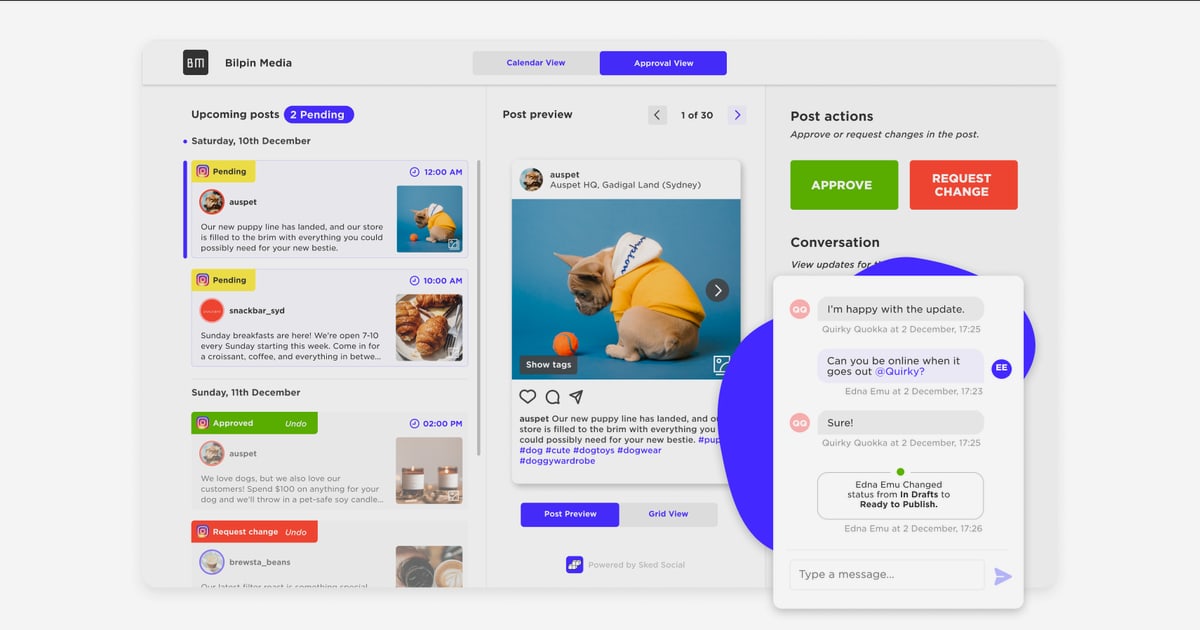
Sked Social product interface.
Sked Social is a social media management platform for planning, scheduling, collaborating on, approving, and reporting on content across multiple networks. It also bundles engagement and monitoring tools, including a unified inbox, social listening, competition monitoring, reputation management, and a link-in-bio page builder.
The platform is aimed at growing teams rather than solo hobbyists. Its stated audiences include agencies, enterprise teams, multi-location brands, restaurant groups, healthcare organizations, hotels, professional services firms, real estate teams, and nonprofits. That range matters because the feature set leans toward coordination problems: multiple approvers, brand guidelines, client reporting, and permission boundaries.
If you are comparing tools at this level, it helps to read adjacent reviews such as this Mailchimp Review 2026 for email-side workflows and this Awario Review 2026 if brand monitoring is a major part of your evaluation.
Core Features That Matter in Daily Use
Scheduling and publishing
The scheduling engine is the foundation, and it is where most user reviews start. Reviewers on G2 consistently highlight ease of use and customer support, and the interface is frequently described as intuitive. On Software Advice, reviewers call out scheduling simplicity and automatic carousel posting as standout capabilities. Carousel publishing is a recurring pain point in social media management, so native support here is a genuine differentiator for Instagram-heavy teams.
AI assistance
AI features help with caption drafting, content ideation, and repurposing. Treat these as accelerators rather than replacements for brand review. The value shows up most when a small team needs to produce a high volume of variations for multiple locations or clients.
Unified inbox and engagement
A unified inbox pulls comments and messages from connected networks into one place. For teams managing community response, this reduces the risk of missed messages and makes assignment and escalation easier. It is most useful when paired with role-based permissions so that junior team members can respond without accessing every account setting.
Social listening and competition monitoring
Listening and competitor tracking help teams catch brand mentions and industry conversations without a separate monitoring subscription. This is a meaningful add-on if you already pay for a standalone listening tool, but it is not a full replacement for a dedicated platform if deep sentiment analysis or historical data is central to your strategy.
Link-in-bio
The built-in link-in-bio tool gives you a branded landing page for profile links. It is convenient for campaigns and product launches, though standalone link-in-bio tools still offer more design flexibility.
Collaboration, Approvals, and Enterprise Security

CBRE logo.
This is where Sked Social separates itself from simpler schedulers. Approval workflows let content move from draft to review to publish with clear ownership. For agencies, that reduces the back-and-forth that happens over email and spreadsheets.
Security is also more developed than many competitors at this price tier. Sked Social holds SOC 2 Type 2 certification and supports SAML SSO, role-based permissions, and audit logs. If you work with healthcare, financial services, or enterprise clients, those controls can be the difference between passing a procurement review and being disqualified.
Reporting and Analytics
Analytics coverage is broad enough to support client reporting and internal performance reviews. Reviewers on Capterra describe the analytics as strong and note the ability to drill down to individual posts. That granularity is useful when you need to explain why a specific campaign worked rather than just reporting aggregate engagement.
The practical limitation is that reporting is designed around social performance, not multi-channel attribution. If you need to connect social activity to pipeline or revenue, expect to export data into a BI tool or analytics platform.
Pricing Signals and What You Actually Pay For
Sked Social uses per-plan pricing with unlimited users on every plan, and it offers a 14-day free trial without a credit card. Unlimited users is an unusual and important detail: most competitors charge per seat, which makes Sked Social comparatively affordable for larger teams even when the headline plan price looks higher.
Because pricing changes and plan tiers vary by region and negotiation, verify current numbers directly with the vendor before budgeting. The decision framework is simpler than the exact figure:
- Cost per seat matters less than cost per team. If you have five or more people touching social, unlimited users usually wins.
- Approval workflows and audit logs are paid-tier features. If you only need scheduling, you may be overpaying.
- Agencies should model client count, not just user count. Multi-client reporting and permissions drive the real value.
Setup and Onboarding
Setup is generally straightforward: connect social profiles, configure permissions, set approval rules, and invite team members. The complexity scales with your organization. A single-brand team can be productive quickly. An agency with multiple clients, approval chains, and SSO requirements should plan a short implementation window and involve IT early if SAML SSO is required.
A practical onboarding sequence:
- Connect one brand or client first and test publishing end to end.
- Configure roles and permissions before inviting the full team.
- Build one approval workflow and run a real campaign through it.
- Set up reporting views that match your client or stakeholder format.
- Only then roll out remaining accounts.
Strengths and Limitations
Strengths
- Unlimited users on all plans, which favors teams over solo users
- Strong scheduling and carousel publishing for visual networks
- Approval workflows, role-based permissions, audit logs, and SAML SSO
- SOC 2 Type 2 certification for security-conscious buyers
- Unified inbox, listening, and competition monitoring in one platform
- Consistently praised ease of use and customer support
Limitations
- Not the cheapest option for a single user managing one or two profiles
- Listening and monitoring are useful but less deep than dedicated tools
- Reporting focuses on social metrics, not revenue attribution
- Enterprise features add setup overhead for small teams
- Pricing transparency requires contacting the vendor for current tiers
Who Should Choose Sked Social

Decathlon logo.
Sked Social makes the most sense for:
- Agencies managing multiple clients with approval and reporting needs
- Multi-location brands that need consistent publishing across many accounts
- Enterprise teams that require SSO, audit logs, and documented security controls
- Regulated industries such as healthcare and professional services
It is a weaker fit for solo creators, very small businesses with one or two profiles, and teams whose primary need is deep social listening rather than publishing and collaboration.
Decision Criteria: How to Choose Between Sked Social and Alternatives

Compass logo.
Use these questions to decide:
- How many people need access? If the answer is more than three, unlimited users changes the math significantly.
- Do you need formal approvals? If yes, prioritize platforms with workflow and audit features.
- Do you manage multiple clients or locations? Agency and multi-location support should be a hard requirement.
- Is security review part of procurement? SOC 2 Type 2 and SAML SSO are non-negotiable in that case.
- Is listening a core need or a nice-to-have? If it is core, compare against a dedicated monitoring tool before committing.
FAQ
Is Sked Social good for agencies? Yes. Approval workflows, multi-client management, unlimited users, and reporting make it a strong agency fit, especially when client stakeholders need visibility.
Does Sked Social offer a free trial? Yes, a 14-day free trial is available without a credit card.
Does Sked Social charge per user? No. All plans include unlimited users, which is a key differentiator against per-seat competitors.
Is Sked Social secure enough for enterprise use? It holds SOC 2 Type 2 certification and supports SAML SSO, role-based permissions, and audit logs, which covers common enterprise procurement requirements.
What is the biggest limitation of Sked Social? Cost efficiency for very small teams. If you only manage one or two profiles, a simpler and cheaper scheduler may be sufficient.
Conclusion
Sked Social earns its reputation as a collaboration-first social media workspace. The scheduling and carousel publishing are solid, the approval and security features are genuinely enterprise-grade, and unlimited users on every plan make the pricing model attractive for teams. The trade-offs are real: it is not the cheapest option for solo users, and its listening and reporting tools are useful but not best-in-class.
If your priority is coordinating many people, clients, or locations with proper controls, Sked Social deserves a serious look and a trial run. If your priority is the lowest monthly cost for one person and a couple of profiles, a lighter tool will serve you better.